With the continuous advancement of China's space station, the country has achieved unprecedented breakthroughs in the field of space research. Recently, the first batch of "space mice" from the space station successfully returned to Earth. After just three months in a microgravity environment, they exhibited astonishing changes in fertility and adaptability. This achievement provides valuable research insights for future deep-space exploration missions and human life in space.
On October 31, 2025, four mice (two males and two females) were launched into China's space station aboard the Shenzhou-21 spacecraft to begin a two-week microgravity adaptation experiment. However, due to a delay in the return of the Shenzhou-20 mission, the mice unexpectedly spent additional time in orbit and relied on soy milk provided by the astronauts to address food shortages. After a three-month journey in space, one of the "astronaut mouse couples" gave birth to three consecutive litters:
First litter: December 10, 2025 – 9 pups
Second litter: January 5, 2026 – 10 pups
Third litter: February 18, 2026 – 9 pups
In comparison to ground-based mice of the same strain (C57BL/6), which typically produce an average of 5–7 pups per litter, the "space mouse mother" produced 2–3 pups per litter, with a total of 28 pups across three litters. This phenomenon has drawn significant attention from researchers, and the research team is investigating the mechanisms behind this enhanced fertility through methods such as blood hormone analysis to explore the impact of the space environment on mouse reproductive capacity.
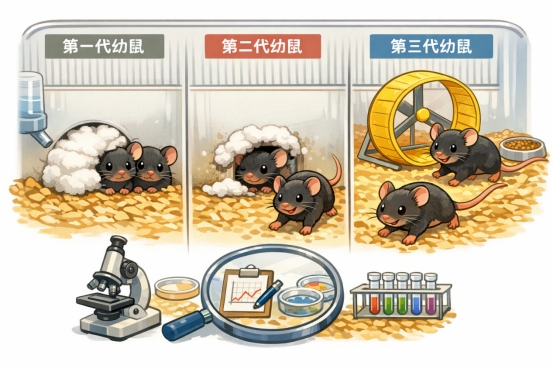
The behavioral changes observed in the space mice have also drawn significant attention from researchers. The three generations of offspring that experienced the space environment exhibited notable behavioral differences:
First-generation pups: Showed "socially avoidant" tendencies, frequently plugging the openings of their cages with cotton and exhibiting very little activity;
Second-generation pups: Gradually relaxed, began partially covering the openings, and actively ventured out to explore and run;
Third-generation pups: Behaved more similarly to ground-based mice, with significantly enhanced adaptability.
These behavioral changes may be related to the heightened maternal protective behaviors induced by the space experience. Space mouse mothers tended to hide their pups together, whereas the ground-based control group exhibited more casual rearing behaviors.
Research mice hold an irreplaceable role in modern scientific research. As mammals, they share 85% genetic similarity with humans, making mice a widely used experimental animal in fields such as biology, pharmacology, genetics, and neuroscience. The short reproductive cycle and rapid growth of mice allow researchers to quickly observe the interactions between multi-generational genetic traits and environmental factors.
In drug development, research mice are widely used as model animals to test drug efficacy and safety. Additionally, mice play an important role in genetic research, helping scientists gain a deeper understanding of gene functions and the mechanisms of genetic diseases. In neuroscience and psychology, mouse models are used to study brain function, neurodegenerative diseases, and behavioral experiments, providing foundational data for understanding the operational mechanisms of the human brain.
Behavioral experiments are an important component of biomedical research. Through the observation and analysis of mouse behavior, researchers can gain a deeper understanding of animal response patterns in different environments, thereby inferring neurobiological and psychological states. Behavioral experiments not only reveal how animals respond during experiments but also provide important clues for drug development, disease research, and psychological treatment.
The behavioral changes observed in space mice are particularly significant. By observing the adaptive changes of three generations of mice in space, researchers can obtain valuable data on how animals cope with extreme environments and adjust their behavior in response to factors such as microgravity. This is of great significance for understanding human physiological and psychological responses in space.
The 85% genetic similarity between mice and humans makes them important models in space research. Studies on space mice have not only revealed the adaptive changes of mice under microgravity conditions but have also provided valuable data for human health research. Research on the fertility and behavior of space mice provides critical support for future deep-space exploration missions. Scientists are conducting long-term monitoring and analysis of data on mouse growth and development, immune systems, bone health, and other aspects to gain a deeper understanding of the multi-generational effects of space on mammals.
This research achievement holds significant implications for future deep-space missions such as lunar bases and Mars colonization, helping researchers address potential health issues that humans may face during long-term space habitation, including bone loss and decreased immunity.