Original title:Time-restricted feeding protects against septic liver injury by reshaping gut microbiota and metabolite 3-hydroxybutyrate
Journal:Gut Microbes
Impact factor:11
In this study, germ-free mice were used to conduct key causal validation experiments to demonstrate the causal role of gut microbiota changes (particularly the microbiota remodeling induced by time-restricted feeding, TRF) and 3-HB production in the protection against sepsis-induced liver injury. (Conducted by Gnotobio Biotechnology)
Research results presentation:
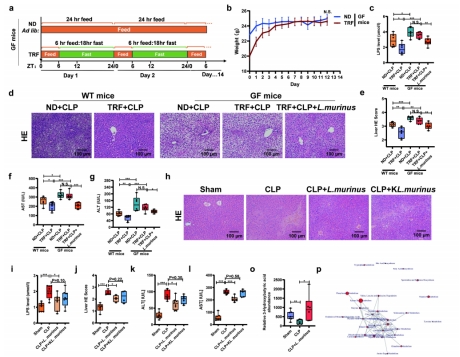
The research team utilized germ-free (GF) mice to validate the role of the gut microbiota, particularly the differential indicator strain Lactobacillus murinus (L. murinus), in the protective effects of time-restricted feeding (TRF) against sepsis-induced liver injury. In wild-type mice, TRF exerted a protective effect against sepsis-induced liver injury; however, this phenomenon was absent in GF mice. Notably, oral gavage of L. murinus into GF mice significantly reduced serum LPS levels and alleviated liver injury. These experiments confirmed the causal chain by which TRF mediates hepatoprotection through gut microbiota remodeling (enrichment of specific beneficial bacteria), providing a solid foundation for subsequent experimental design.