Original title:An interplay between human genetics and intratumoral microbiota in the progression of colorectal cancer
Journal:Cell Host & Microbe
Impact factor:18.5
In this study, a germ-free mouse tumor-bearing model was used to perform key causal validation of the pro-tumorigenic role of F. nucleatum in the context of low KCNJ11 expression. (Conducted by Gnotobio Biotechnology)
Research results presentation:
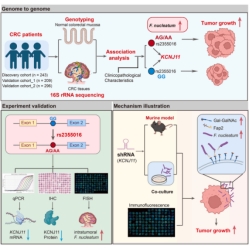
The population data and in vitro experiments in the study demonstrated that the rs2355016 A allele (associated with low KCNJ11 expression) is positively correlated with intratumoral Fusobacterium nucleatum abundance and promotes bacterial adhesion and invasion.
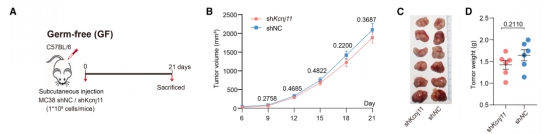
The research team first constructed a subcutaneous xenograft germ-free mouse model using colorectal cancer (CRC) cells with low KCNJ11 expression to validate the role of the KCNJ11 gene. The results showed that tumor growth was slightly, though not significantly, slowed in mice with low KCNJ11 expression. The team hypothesized that low KCNJ11 expression requires the presence of Fusobacterium nucleatum to accelerate tumor progression, and accordingly designed a series of subsequent validation experiments.