Original title:Gut–liver translocation of pathogen Klebsiella pneumoniae promotes hepatocellular carcinoma in mice
Journal:Nature Microbiology
Impact factor:19.4
In this study, germ-free mice were used to conduct key causal validation experiments on the translocation and pro-tumorigenic mechanisms of HCC-associated microbiota / K. pneumoniae. (Conducted by Gnotobio Biotechnology)
Research results presentation:
A DEN (diethylnitrosamine)-induced germ-free mouse model of HCC was established, followed by FMT from HCC patients or mono-colonization with K. pneumoniae. In the germ-free background, HCC-FMT or K. pneumoniae colonization led to accelerated liver inflammation, fibrosis, dysplasia, and tumor progression, whereas no such effects were observed in the normal donor FMT or germ-free control groups.
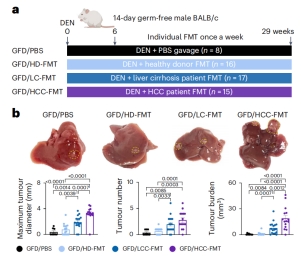
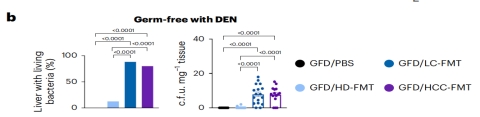
These experiments confirmed the causality of gut-liver translocation: K. pneumoniae specifically promotes carcinogenesis in germ-free cirrhotic/HCC models via the PBP1B-TLR4 axis to activate cancer cell proliferation. Furthermore, targeted interventions (e.g., competitive colonization with K. oxytoca or TLR4 inhibitors) significantly suppressed progression in these models, validating the mechanism.