Original title:Gut microbial-derived phenylacetylglutamine accelerates host cellular senescence
Journal:Nature aging
Impact factor:19.5
In this study, germ-free mice were used for key mechanistic validation experiments, particularly to demonstrate the causal relationship between gut microbiota changes and PAGln production / cellular senescence. (Conducted by Gnotobio Biotechnology)
Research results presentation:
In germ-free (GF) mice colonized with G. pamelaeae, whose metabolite is phenylethylamine (PEA), a significant increase was observed in the expression of cellular senescence markers in the kidney and lung, as well as in serum PAGly levels. These results indicate that PAA-producing bacteria can promote host cellular senescence in vivo.
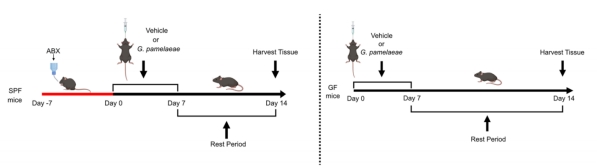
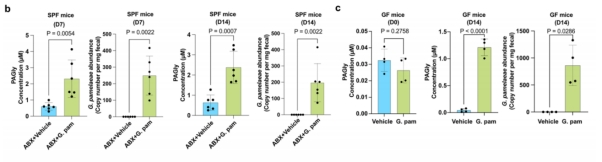
The above experiments are central to the causal chain: germ-free (GF) mice, lacking gut microbiota, exhibit a slower aging process; transplantation of aged microbiota or supplementation with PAGln accelerates aging, demonstrating that PAGln is a key metabolite in microbiota-driven aging. Furthermore, blockade of ADR (e.g., using an ADR antagonist) or treatment with senolytics (e.g., dasatinib + quercetin) reversed PAGln-induced aging in these models, validating the signaling pathway.